


A Journey to Albania
Updated: Jan 14
Our Albanian guide told us that it is a misconception to refer to Albania as a Muslim country,
and that there is no crime in Albania at all. He mentioned that traffic rules formally exist, but
no one follows them.

We set off in front of Tito’s “House of Flowers” – heading towards Albania. Symbolic or not, our tour guide recounted in detail the entire history of the relationship between Josip Broz and Enver Hoxha, of course mentioning nothing about tourism and present-day Albania...As we approached the Merdare crossing, he jolted us from our evening nap with the words:
“Prepare your ID cards, you only need your ID cards, we are approaching – seen from our
side as the administrative crossing of Merdare and from their side – the national border.”
We passed after a brief check of our ID cards. For children and all minors, a birth certificate is
required. We continued our drive through Kosovo towards Albania. Later, at one point, the guide’s voice broke the night’s silence.
“Dear passengers, we have been on Albanian territory for over an hour. You realize there is no border, no control, no crowds, no waiting…”
And then he continued again about Tito and Enver Hoxha, and all the successes and failures of communism. One of the passengers commented that he regretted not getting a stamp in his passport. Who will believe that he was in Albania… Data on the population varies, depending on who tells you, but they say the local population is around 20,000 to a maximum of 40,000. Our hosts at the hotel are more than kind. They ask where we are from and enthusiastically hug us.
“The people from Serbia are very good people, many good people,” they tell us… They inquire about how things are with us, how we live, and they talk about life in Albania.
“Tourists come from all over Europe. The whole Balkans are here with us.”
And we confirmed that during our stay. Serbian could be heard at every turn; we met quite a
few of our people, as well as people from Bosnia and Herzegovina, Germans, Danes, and a large number of Russians—specifically Russian women of all ages and children, with only a few older Russians in advanced retirement age.
Important Instructions
We were immediately warned not to drink water from their water supply, that is, from the tap in the hotel or anywhere else. "The water is safe, but it's different from what you're used to, and it might cause some discomfort, so make sure to buy bottled water in stores." They repeated daily that if we needed a doctor, we could freely go to their emergency service (something like our emergency center), "they won't charge you anything." Since we didn't need anything related to COVID to enter Albania – neither a vaccine nor a test – we asked what the situation was like there. "COVID is just to drive people crazy, there's none here, you can see everyone is healthy," the hotel hostess told us. I asked if there had been any sick people, and they said - a few at the beginning, but now none. I mentioned that they probably got vaccinated earlier than citizens in other countries. "No way, we don’t get vaccinated, nobody wants that…" "Why?" "We don't want them to inject us with chips…" We all laughed together.
Traffic
Formally, there are traffic rules, but no one follows them, was the next warning: "Be careful…", and indeed, it was like that.
The streets are too narrow, there are countless cars and buses, and it often happens that they
simply get stuck in one place, spending 10-15 minutes trying to clear the way to continue driving. What’s fascinating is that no one gets hysterical, no one swears, they patiently wait for the jam to clear up. At pedestrian crossings, rarely does anyone stop for pedestrians to cross, and it’s mostly women drivers who sometimes do. In public transport, the conductor collects fares. One ride costs 100 lek, which is like 100 dinars. Whenever we got on the bus and gave 200 or 300-400 lek (depending on how many of us there were), he would give half back, saying, "You’ll need it, it's fine..." We laughed, imagining our BusPlus inspectors in Belgrade giving us back some of the money we paid for the bus ride because we genuinely don't have enough money. As for politics, it’s as if it doesn’t exist. You will never hear an Albanian say a word on that subject, or on relations with Serbia, or anything regarding Kosovo. If you ignore the fact that one of the hotels is called "Pristina," and a bakery in Saranda is named "Kosovo," and that flags of Albania, America, and the European Union fly over many of the 400 hotels, we could have thought we were in some far-off corner of the world.

Beaches
You can use any beach. Some charge for the use of sunbeds, while on so-called public beaches, there is no charge. Most beaches are covered with sharp pebbles, so you'll need some kind of footwear – flip-flops or beach shoes. Some hotels have their own private beaches, and in those cases, sunbeds are free if you are a guest at the hotel.
Saranda is also a port where various ships dock. There are boats and small ships that take tourists on excursions to distant beaches or ones that are inaccessible from land. The price for
such trips is around 20 euros, but you can also negotiate.
Payments
In cafes and restaurants, you can pay in the local currency, lek, or in euros. You can exchange
money at currency exchange offices, but if you haven't done so, don't worry – in every store or restaurant, they will either exchange money for you or simply accept euros. Many products
from Serbia are available in the stores, including wines from various producers, dairy products, and confectionery. We noticed a sticker on a milk carton labeled "Moja Kravica," which indicated it was imported from Kozarska Dubica. Prices are significantly lower than in Serbia. It often happened that after a meal, we were served watermelon or melon for free – a gift from the owner.

English
In the center of Saranda, there is a restaurant called "Old Story," owned by a Serbian. In every hotel, there is at least one person who speaks English well enough to have a conversation about anything without any problem. Many people know a number of phrases, and you'll feel like you've communicated well. On one occasion, we tried to have a more in-depth conversation with the owner of the hotel where we were staying. After some polite conversation – how was your day, are there new guests, etc. – we asked her what it was like when it rains in Saranda since we had read that it is sunny and warm all year round, with maybe one rainy day annually.
Confidently, she said that there are very few tourists in October. We repeated the question, and her answer was similar – there aren't many tourists in November either. We tried asking the same in Russian, Italian, and French, and she went on listing the number of tourists for December, January, and February... and then mentioned that in March, the influx of tourists picks up again.
Spaghetti and a Spoon
Most people who visit Albania speak in superlatives about their experiences. On our way back, I asked a friend what he didn't like. After a brief pause, he said that he was annoyed that
at the restaurant where he frequently had lunch, they served him spaghetti with a spoon. I asked, "What bothered you – the spaghetti or the spoon?" He got irritated and said: "The lack
of a fork and knife." Why didn’t you ask for one?!
Well, I don't know... I ate like a dog...
Safari
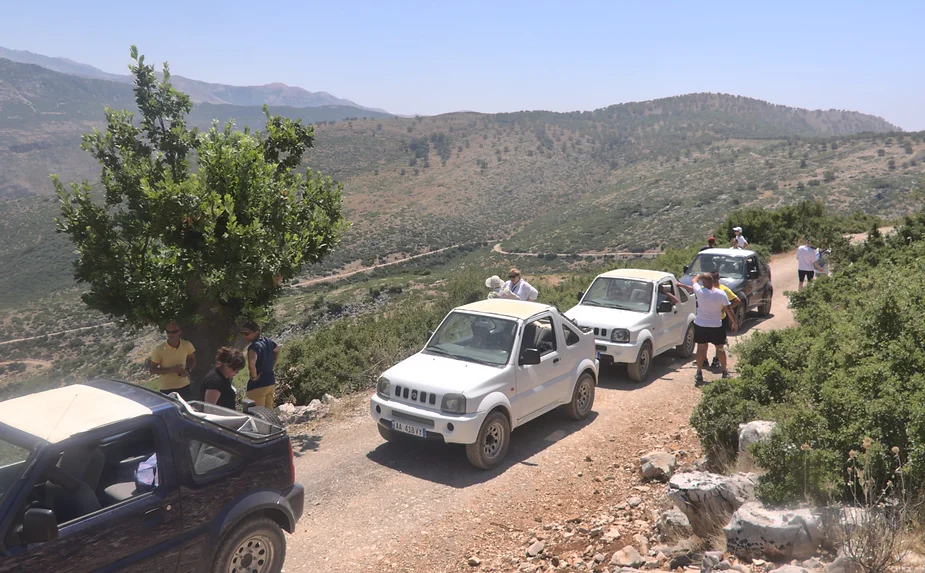
A jeep comes to pick us up, and we set off to visit two of what our hosts recommended as the
most beautiful and authentic Albanian villages in the southern continental part of the country – Borsh and Pilur. We're joined by a few cheerful Russian women.
On this journey, we visited the Porto Palermo Castle in the bay of the same name, near Himara. During the communist era in Albania, the Porto Palermo Fortress was a Soviet submarine base. The tunnel and barracks in front of it remind us of that time, however, the visit is not allowed as two submarines are still inside, and cows rested in the shade near the barracks. Not far from there, many bathers enjoyed the beach.
“The base was designed and built by Soviet engineers under the command of Admiral Zhukov”, our guide explained in broken Russian. We asked him why he was speaking Russian when he was better at English. He said it was because he liked one of the Russian women and because he had studied in Moscow. We laughed – "You speak Russian so well that even she doesn't understand you." He laughed too, adding that it didn’t matter – It's important to put in effort.
Religion in Albania
Our Albanian guide told us that it is a misconception to refer to Albania as a Muslim country.
Albanians adopted Christianity during the time of the Roman Empire. As for Muslims - during the Ottoman Empire, some families converted to Islam, mostly the poorer population who couldn’t afford the tax on their faith.
After the breakup of relations with the Soviet Union, Orthodox churches, whose construction had been funded by the Romanov family, were destroyed.
We visited the site where the Monastery of St. Mary once stood, one of those built by the Romanovs. Only the stone walls remain, and high on a hill beside the road stands a small replica of the monastery. The monastery was destroyed during communism.
In the old village of Pilur, where Orthodox Christians live, we visited a small church dedicated to St. Nicholas, and afterward, we had lunch with a local family – enjoying traditional local specialties.
Our host, an Albanian named Vasilj, and his wife, who came from Georgia 30 years ago out of love for him, welcomed us as dear friends to this rocky village of Pilur. Vasilj served us his homemade rakija as a welcome gesture, which particularly impressed the men in our group, and they took a liter each with them when leaving Pilur.
It's amazing that on this rocky hill, at such an altitude, there is water flowing from the taps. We commented on how some coastal towns in Montenegro have issues with water supply.

Crime
Our guide assured us that there is absolutely no crime in Albania, “zero cases of crime.” Albanians who commit criminal acts do so in European countries, and this has nothing to do with Albania. He reassured us that this is achieved through strict penalties for both the perpetrators and their families.
Museum of the City of Saranda and Gallery
It was only after our fourth attempt that we managed to find the museum open, as there was no information about when and how it operates.
The lady we encountered one early morning at the museum told us that the museum operates
in two shifts but sometimes closes early. She explained that the current building of the museum was once the customs headquarters, then it housed the tourist organization, and for
the past 10 years, it has been home to exhibits that testify to the lives of people in this area. She was neither willing nor interested in telling us anything about the exhibits themselves, even though we introduced ourselves as journalists and showed our credentials. She directed
us to wander around the rooms on our own.
Not far from the museum is the art gallery of Albanian artists, where visual and sculptural works by unknown authors are displayed. The gentleman we met in the gallery assured us that he did not know a word of English, so we couldn’t learn anything from him about the exhibited works or their authors.


Comments